
Portland guide · 9 min read
House Washing vs Pressure Washing in Portland: Which Method Your Surface Actually Needs (2026)
House washing in Portland, Oregon uses under 500 PSI with a cleaning solution (soft wash); pressure washing uses 2,000 to 4,000 PSI of water alone. As of May 2026, soft wash is correct for cedar shake, painted siding, roofs, and most vinyl; high-pressure is correct for concrete, brick, and unsealed driveways. Using the wrong method strips paint, lifts cedar grain, and voids siding warranties.
By Monte Wallenstein Published
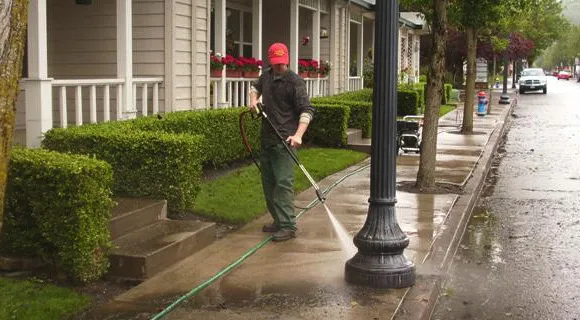
House washing and pressure washing are not the same service. In Portland in 2026, house washing means a soft-wash process under 500 PSI with a cleaning solution that does the work, while pressure washing means 2,000 to 4,000 PSI of water alone for hard surfaces. Using the wrong method on the wrong surface is the most common way Portland homeowners end up with stripped paint, lifted cedar grain, water-damaged siding, and a re-paint bill they didn’t budget for.
This guide walks through the difference, which method is correct for each common Portland exterior surface, what salmon-stream-safe chemistry actually looks like in the PNW, and where DIY ends and a pressure washing crew begins.
The core difference: chemistry versus force
It is easiest to think of it this way:
- Pressure washing uses water as a weapon. Raw force does the work. Suitable for surfaces that can take the hit — concrete, brick, unsealed pavers.
- Soft-wash house washing uses chemistry as the cleaner. A diluted sodium hypochlorite solution lifts organic growth (mildew, algae, moss) off the surface; a low-pressure rinse removes it. Suitable for everything else.
The 4-second test: if the surface has paint, stain, sealer, finish, wood grain, asphalt granules, or shingles on it, soft-wash. If it is raw stone, concrete, or brick, pressure wash is on the table.
Side-by-side comparison
| Factor | Soft-Wash House Washing | High-Pressure Washing |
|---|---|---|
| PSI at the nozzle | Under 500 PSI (often 100–200) | 2,000–4,000 PSI |
| Primary cleaning mechanism | Chemistry (sodium hypochlorite solution + surfactant) | Mechanical force of water |
| Dwell time on surface | 5–15 minutes | None — instant action |
| Risk to paint, stain, wood grain | Minimal when properly diluted | High — strips finishes |
| Risk to roof shingles | Safe at proper dilution | Strips granules, voids warranty |
| Best for | Siding, roofs, painted fences, cedar, decks (with care) | Concrete, brick, unsealed pavers |
| Water volume used | Lower — 4–8 gallons per minute typical | Higher — 4–6 GPM at higher force |
| Operator skill required | High — chemistry knowledge matters | Moderate — but tip selection critical |
| Cost to homeowner | Comparable | Comparable |
The dollar cost is roughly the same; the method must match the surface.
Surface-by-surface matrix: which method for what
The following matrix reflects established Portland trade practice in 2026.
Vinyl siding
Soft wash. Vinyl can technically take more pressure but the laps are designed to shed water from above, not handle a horizontal high-pressure stream. Pressure washing vinyl forces water behind the siding where it can sit against the sheathing — a real problem in 36 inches of annual Portland rainfall. Soft-wash chemistry at under 500 PSI removes the green and black mildew streaks that develop on north walls without the moisture intrusion risk.
Cedar shake or cedar siding
Soft wash only — hand-brush technique. Cedar is the most damage-prone exterior surface in the PNW. PSI above 500 strips the natural cedar oils and tannins that give it weather resistance and lifts the grain, accelerating rot. Anything over 1,000 PSI on cedar is destructive. The correct method is a hand-brush soft wash with a mild sodium hypochlorite solution and a low-volume rinse. See our soft-wash cedar shake guide for the full protocol.
Painted siding (Hardie, LP SmartSide, painted wood)
Soft wash. High pressure on painted siding strips paint, period. Even 1,500 PSI will lift a coat of paint that is more than 5–7 years old, which describes most painted homes in Portland. Soft-wash chemistry cleans without abrading the paint film. Hardiplank and LP SmartSide manufacturers explicitly recommend soft-wash methods in their warranty documentation.
Brick
Either method, with care. Solid brick masonry tolerates pressure washing at 2,000–2,500 PSI with a wide tip from 12+ inches away. The mortar joints are the weak point — old or eroded mortar can blow out under high pressure. For older Portland homes in Laurelhurst, Alameda, or Eastmoreland with brick chimneys or partial brick facades, soft wash is the safer default.
Concrete driveways, patios, walkways
Pressure wash. This is where high pressure earns its keep. Use 3,000–4,000 PSI with a surface cleaner attachment for even results without the wand-stripe pattern. A pre-treatment with sodium hypochlorite solution lifts moss and Douglas fir tannin staining before the rinse. Avoid zero-degree tips, which etch the surface and leave permanent stripes.
Stamped, colored, or sealed concrete
Pressure wash at lower PSI. Drop to 1,500–2,500 PSI to avoid breaking the sealer. A surface cleaner attachment helps maintain even contact distance.
Wood deck
Soft wash + light pressure. Wood decks need cleaning chemistry to lift mildew, then a light pressure rinse (under 1,500 PSI with a wide fan tip, always moving in the direction of the grain). Most deck damage comes from holding a narrow tip too close and gouging the wood. Soft wash first, then minimum pressure to rinse.
Painted fence
Soft wash. Same logic as painted siding. Pressure washing a painted fence strips the paint inside two passes.
Asphalt shingle or composite roof
Soft wash only. Pressure washing asphalt shingles strips the granular surface that gives shingles their UV and weather resistance and voids manufacturer warranties. The Asphalt Roofing Manufacturers Association (ARMA) explicitly recommends low-pressure soft wash as the only acceptable cleaning method. See our Portland roof moss removal guide.
Tile or composite roof
Soft wash only — same as asphalt. High pressure on concrete tile cracks and dislodges tiles; on clay tile, it can shatter them outright.
Why salmon-stream-safe chemistry matters in the Portland watershed
Every storm drain in the Portland metro flows downhill to the Willamette River or one of its tributaries — Johnson Creek, Tryon Creek, Fanno Creek, Kellogg Creek. These waterways support spring and fall chinook, coho, and steelhead runs that Oregon law protects under the Clean Water Act and the Endangered Species Act.
What that means for your pressure washing crew:
- Sodium hypochlorite at low dilution breaks down quickly in soil contact and does not bioaccumulate. It is the standard PNW soft-wash chemistry for this reason.
- No phosphate detergents — banned in Oregon since 2010 for residential cleaning runoff.
- No oxalic acid wood brighteners rinsed directly to drains. Oxalic acid is acutely toxic to fish. Some Portland deck-restoration operators still use it; ask before they show up.
- Contained runoff on driveway and concrete jobs — bermed mats or vacuum recovery to keep the cleaning slurry out of the storm drain.
- Landscape-friendly rinse — directing rinse water to bermed soil where chemistry breaks down before reaching streams.
A Portland pressure washing contractor who can’t explain their runoff protocol in plain language is a contractor who hasn’t thought about it. We are happy to walk through ours on any quote.
When pressure washing is genuinely the right answer
Despite the soft-wash emphasis above, there are jobs where high pressure is correct, fast, and the obvious tool:
- Moss-stained concrete driveway in Sellwood, Laurelhurst, or anywhere under big-leaf maple cover
- Brick patio with embedded grime that soft wash alone won’t budge
- Garage floor with oil stains and traffic dirt
- Retaining walls of cast concrete or natural stone
- Public sidewalks and steps with built-up Douglas fir tannin staining
For these surfaces, a 3,500-PSI machine with a surface cleaner attachment, a pre-treatment dwell, and a final rinse produces results that no soft wash can match.
Where house washing fits in your annual Portland maintenance cycle
The PNW exterior cleaning rhythm runs:
- March–May: Moss treatment and roof soft wash after wet winter
- April–June: Annual or biennial house wash — green and black streaks from winter mildew lift cleanly in spring chemistry
- June–August: Driveway and concrete pressure washing — dry conditions make for fast turnaround
- October–November: Gutter cleaning after Douglas fir and western red cedar drop
- Year-round: Window cleaning on whatever rotation fits your home
For the full month-by-month plan, see the PNW seasonal maintenance calendar.
DIY vs hire — where the line is
A homeowner with a rented pressure washer can reasonably handle:
- Concrete driveway pressure washing (avoid the zero-degree tip)
- Small concrete patio cleanup
- Garage floor
A homeowner should not DIY:
- Any roof cleaning — soft-wash chemistry on a wet, sloped surface is not a rental-counter education
- Cedar shake or cedar siding — hand-brush technique requires practice
- Painted siding — too easy to strip paint
- Anything over a single story — ladder + pressure wand is a serious injury risk
For the broader DIY question, see our DIY vs professional gutter cleaning guide. The same logic applies to most exterior cleaning.
Quick Recap
- House washing in Portland is soft wash under 500 PSI with cleaning solution; pressure washing is 2,000–4,000 PSI of water alone.
- Soft wash is correct for cedar, painted siding, vinyl, roofs, and most house exteriors; high-pressure is correct for concrete, brick, and unsealed driveways.
- Cedar shake and cedar siding must never see a pressure washer — under 200 PSI hand-brush only.
- Salmon-stream-safe chemistry means sodium hypochlorite at low dilution, no phosphate detergents, no oxalic acid to storm drains, and contained runoff.
- Most Portland homes need a soft-wash house wash every 18–24 months; heavily shaded properties in the West Hills, Lake Oswego, and West Linn often go annual.
- DIY is reasonable for concrete; hire a pressure washing crew for anything painted, wooden, or above a single story.
Frequently asked questions
- What is the difference between house washing and pressure washing in Portland?
- House washing in Portland is a soft-wash process under 500 PSI that uses a cleaning solution to lift organic growth from siding and roofs. Pressure washing in Portland uses 2,000 to 4,000 PSI of water alone to physically blast dirt off hard surfaces like concrete and brick. Soft wash protects the surface; pressure wash relies on raw force. The methods are not interchangeable and using the wrong one causes damage.
- Can I pressure wash cedar shake siding or a cedar roof in Portland?
- You should never pressure wash cedar shake siding or a cedar roof in Portland. PSI above 500 strips the natural oils and tannins that give cedar its weather resistance, lifts the grain, accelerates rot, and voids most refinish warranties. Cedar requires hand-brush soft wash under 200 PSI with a mild sodium hypochlorite solution. This is one of the most damaging mistakes in PNW exterior cleaning and the source of most premature cedar replacement.
- What PSI is safe for vinyl siding in Portland?
- Safe PSI for Portland vinyl siding is 500 to 1,500 PSI at most, applied at a wide fan angle from at least 18 inches away. Soft-wash chemistry under 500 PSI does the same job without risking water intrusion behind the laps. Vinyl is forgiving compared to cedar or paint, but high pressure forces water behind the siding, where it traps moisture against the sheathing — a real problem in 36-inch annual rainfall.
- Is pressure washing safe for concrete driveways and patios?
- Pressure washing is the correct method for unsealed concrete driveways and patios in Portland, typically at 3,000 to 4,000 PSI with a surface cleaner attachment. Concrete tolerates high pressure well and benefits from the mechanical action against ground-in moss, oil, and Douglas fir tannin staining. Sealed or stamped concrete drops to 1,500 to 2,500 PSI to avoid breaking the sealer. Avoid zero-degree tips, which etch the surface.
- Are pressure washing chemicals safe for Portland salmon streams?
- Reputable Portland pressure washing crews use sodium hypochlorite at low dilution and rinse to a contained landscape area, never directly into storm drains. Storm drains in the Portland metro flow to the Willamette and tributaries that support salmon and steelhead runs. Salmon-stream-safe practice means catching runoff with bermed mats, neutralizing solution before rinsing to drains, and avoiding phosphate-heavy detergents banned in Oregon since 2010. Ask your contractor about runoff containment.
- How often should a Portland home be soft-washed?
- Most Portland homes benefit from a full soft-wash house wash every 18 to 24 months as of 2026. Heavily tree-shaded properties in the West Hills, Lake Oswego, and West Linn, or homes on the north-facing side of a slope where mildew grows fastest, often need annual service. South-facing, sun-exposed homes in Beaverton or Tigard can stretch to every two to three years. Watch for the green or black streaks on north walls as your scheduling cue.
- Can I rent a pressure washer and do this myself?
- You can rent a pressure washer for concrete and driveway work in Portland, but DIY pressure washing of siding, decks, and especially roofs causes more damage than the cleaning is worth in most cases. Rental units default to 2,500 to 3,500 PSI with a zero-degree tip in the kit — both wrong settings for siding. If the surface is wood, paint, vinyl, or roof, hire a soft-wash crew or skip it.
Related guides
-
11 min read
Portland Roof Moss Removal Guide
Honest Portland roof moss guide: why PNW roofs grow it, why soft-wash beats pressure, zinc strips, salmon-safe...
-
9 min read
DIY vs Professional Gutter Cleaning: An Honest Portland Guide
Honest take from a 16-year Portland contractor: when DIY gutter cleaning is fine, when to call a pro, ladder s...
Ready to book?
Want gutters, moss, and windows on one annual schedule? Home Exterior Care Plan
Property manager, HOA, or commercial site? Property managers & HOAs Commercial cleaning
Need help with your Portland home exterior?
Same-day quotes by phone. No high-pressure sales. Bonded & insured · Family-owned since 2009
Happy with our work? Leave a Google review · Find us on Google Maps