
Portland guide · 9 min read
Gutter Guards in Portland: What Actually Works in Conifer Country
Gutter guards work in Portland only when chosen correctly: micro-mesh and fine-pitch screens perform reasonably well against Douglas fir needles, while foam inserts and large-screen guards generally fail in PNW conifer country. Installed costs typically run $7-$15 per linear foot in Portland (2026), and even the best guards still need annual maintenance. They're worth it on two-story or hillside homes where access alone justifies the investment.
By Monte Wallenstein Published
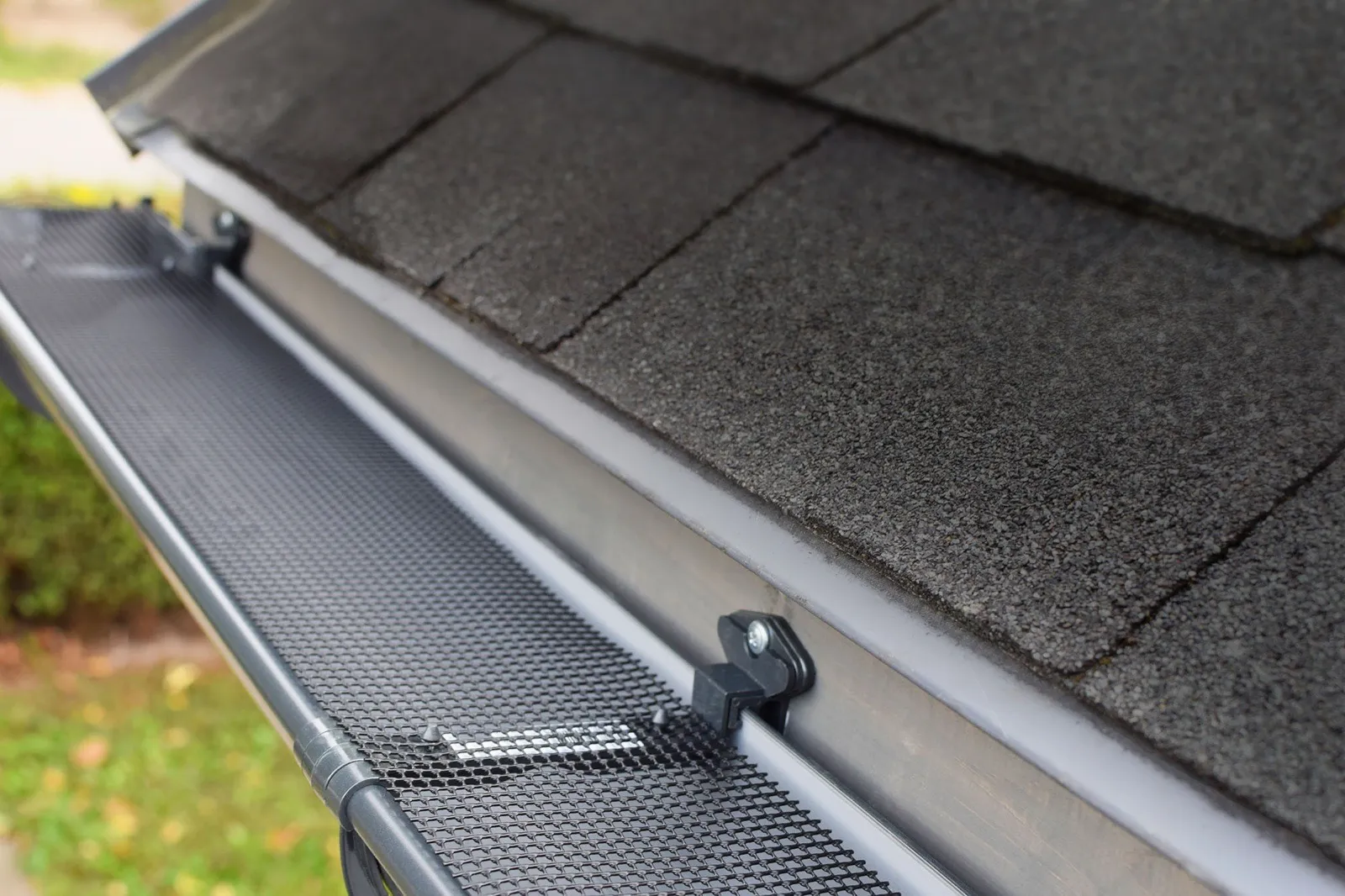
Here’s the honest answer: gutter guards work in Portland only when you pick the right kind. Micro-mesh stainless steel and fine-pitch perforated metal screens do okay against Douglas fir needles. Foam inserts, big plastic screens, and most reverse-curve “Gutter Helmet” style products fail in PNW conifer country.
Installed costs in 2026 typically run $7 to $15 per linear foot depending on the type. Even good guards still need annual inspection — they reduce the cleaning frequency, they don’t eliminate it. The honest economic case is strongest on two-story and hillside homes where access alone justifies the upfront investment.
This guide compares the four common types, gives realistic Portland cost ranges, and lays out when guards are worth it and when they’re not.
Why Portland is a hard test for gutter guards
Most gutter guard marketing assumes a deciduous-leaf model: one fall leaf drop and your gutters stay clean the rest of the year. The PNW reality is different:
- Douglas fir needles are tiny, sharp, and slip through almost any opening larger than about 1 millimeter. They also don’t blow off — they weave together and stick.
- Western red cedar needles behave similarly.
- Eight-month rain season means anything that does collect on top of the guard stays wet and starts growing.
- Pollen and moss spores accumulate in fine mesh and reduce flow over time.
- Heavy rainfall intensity during atmospheric river events tests whether the guard actually lets water through fast enough.
A gutter guard that works fine in Phoenix or Atlanta may completely fail under a Sellwood maple-and-fir canopy. The PNW is harder on this product category than almost any other region.
The four main types: how they actually perform in Portland
| Type | Cost installed (Portland 2026) | PNW performance | Verdict |
|---|---|---|---|
| Micro-mesh stainless steel | $10–$15 / linear ft | Best in class for fir needles; fine debris accumulates on top | Worth considering on two-story homes |
| Fine-pitch perforated metal | $8–$12 / linear ft | Decent; some small needles slip through | Reasonable mid-range option |
| Foam inserts | $3–$6 / linear ft | Poor — needles pack on top, foam degrades, moss grows in it | Skip in PNW |
| Reverse curve / “helmet” style | $15–$25+ / linear ft | Poor — needles slip into the slot, large debris bridges over | Skip in PNW |
| Plastic large-screen guards | $4–$8 / linear ft | Poor — gaps too large for fir needles, plastic warps | Skip in PNW |
Let’s go through each.
Micro-mesh stainless steel
This is the only category I’d recommend without major caveats for Portland homes. Stainless steel micro-mesh has openings small enough (typically 50–200 microns) to keep fir needles, maple seed pods, and most pollen out, while still passing rainfall volumes adequate for atmospheric river events.
What works: The mesh itself is durable, doesn’t rust, doesn’t degrade in UV, and has small enough openings to defeat conifer debris.
What doesn’t: Fine debris (cedar leaflets, pollen, moss spores, accumulated grit) builds up on top of the mesh over time. Without periodic brushing or rinsing, the mesh can begin to surface-clog. You’re not cleaning the gutter anymore — you’re cleaning the guard.
Maintenance: Plan on annual inspection and brushing or rinsing of the mesh top. This is dramatically less work than cleaning the gutter twice a year, but it’s not zero.
Fine-pitch perforated metal screens
A step below micro-mesh in performance but cheaper. Perforated aluminum or steel sheet with holes typically 0.5–2mm. Keeps out most debris but lets some fir needles through, especially when the holes are at the larger end of that range.
Best use case: Homes in less conifer-dominant neighborhoods (parts of Beaverton, Hillsboro, Tigard where suburban tree cover is mostly deciduous) can get acceptable performance from this category.
Foam inserts
The big-box-store option. A foam log that sits inside the gutter, theoretically letting water filter through while debris sits on top.
Why it fails in Portland: Fir needles embed into the foam surface and don’t blow off. Moss spores germinate in the wet foam. The foam itself degrades after 3–5 years of PNW UV and rain cycling. We pull these out of customer gutters all the time, fully embedded with debris, doing the opposite of what they were sold to do.
Reverse-curve / “helmet” style
These guards use a curved surface that’s supposed to direct water into a narrow slot at the front of the gutter while leaves and debris slide off. They work on big dry leaves; they fail on fir needles.
Why it fails: Fir needles slide right into the slot. Large wet leaves bridge across the curve and form a dam. Heavy rainfall events can overshoot the slot entirely. We also see these voiding roof warranties because installation often requires lifting the bottom shingle course.
Plastic large-screen guards
Cheap plastic screens with openings of about 5–8mm. These work on giant oak leaves and not much else.
Why it fails: Every PNW debris type — needles, catkins, pollen, moss runoff — passes right through. Sometimes the screen itself fills with debris on top and warps in UV.
What gutter guards actually cost in Portland
For a typical 180-linear-foot Portland two-story home in 2026, install pricing breaks down roughly:
| Guard type | Material cost | Install labor | Total installed range |
|---|---|---|---|
| Foam inserts (DIY) | $300–$600 | $0 | $300–$600 |
| Foam inserts (installed) | $300–$600 | $300–$500 | $600–$1,100 |
| Fine perforated metal (installed) | $700–$1,200 | $700–$1,000 | $1,400–$2,200 |
| Micro-mesh stainless (installed) | $1,000–$1,800 | $800–$1,200 | $1,800–$3,000 |
| Premium “lifetime” brands (LeafFilter, LeafGuard, Gutter Helmet) | Often $4,000+ | Bundled | $4,000–$8,000+ |
A note on the premium brands: heavy national marketing, high-pressure sales tactics, and prices that don’t match what the product actually delivers in PNW. Some are micro-mesh products in disguise selling at 3–4x the local installer rate. Get multiple quotes.
When are gutter guards worth it?
Honest cost-benefit:
Worth it (usually)
- Two-story or three-story homes where ladder access is genuinely difficult or expensive. The cost of professional cleaning is highest here, and reducing frequency has real value.
- Hillside or canyon lots in Lake Oswego, West Linn, or the West Hills where ladder setup adds time and cost to every cleaning.
- Owners planning to stay 10+ years so the upfront cost amortizes.
- Rental properties where ongoing service-call coordination is annoying.
Probably not worth it
- Single-story rancher with easy access. Two pro cleanings a year at $150–$225 is about $300–$450 annually. Guards at $1,400–$2,700 take 4–6+ years to break even, and you still need maintenance.
- Owners planning to move within 5 years. Hard to recoup the install cost in resale value.
- Homes with foam or large-screen guards already installed. Removing bad guards and going back to clean gutters is often the right move.
Installation: pro vs DIY
Some micro-mesh guards are reasonably installable by a handy homeowner with the right ladder. Most aren’t — proper installation requires precise alignment to the gutter, secure attachment without compromising the roof edge, and matching the guard to the gutter profile.
DIY makes sense for:
- Foam inserts (but we’d recommend against the product anyway).
- Snap-in screen guards on single-story homes.
Professional install makes sense for:
- Any micro-mesh product.
- Any two-story or hillside install.
- Anything that requires modifying the gutter or roof edge.
Critical: Confirm the install method does not require lifting the bottom shingle course. That installation practice can void roof warranties from major manufacturers (GAF, CertainTeed, Owens Corning all flag it).
Honest middle path: clean gutters, no guards, on a schedule
For maybe two-thirds of Portland homes, the simplest answer is the right one: stay on a twice-yearly cleaning schedule, skip the guards, and put the $1,500–$2,500 you didn’t spend on guards toward something with a clearer return.
Twice-yearly professional gutter cleaning gives you:
- Full debris removal (not just deflection)
- Downspout flushing
- Photo documentation
- Inspection of hangers, fascia, and roof edge
- Catching small problems before they become repairs
Guards don’t give you any of those things — they just reduce frequency. For high-access homes, that’s not enough to justify the cost.
When we recommend guards to our own customers
For context, when we do recommend gutter guards, it’s typically for:
- Three-story homes where every cleaning is an expensive setup
- Hillside Lake Oswego and West Linn properties where one elevation is functionally three stories
- Commercial properties with safety-protocol overhead on every service visit
- Property managers handling multi-building portfolios where reducing service-call coordination has operational value
For the standard Portland two-story under moderate tree cover, we’ll usually tell people the math doesn’t work and recommend staying on the cleaning schedule instead. That’s the trade.
Quick Recap
- Only micro-mesh stainless steel and fine-pitch perforated metal screens work reliably in Portland’s conifer country.
- Foam inserts, large-screen guards, and reverse-curve “helmet” products fail against Douglas fir needles.
- Installed costs in 2026 typically run $7–$15 per linear foot for quality guards; $1,400–$2,700 total on a typical two-story home.
- Even the best guards still need annual inspection and maintenance — they reduce cleaning frequency, they don’t eliminate it.
- Guards are worth it on two-story, hillside, or hard-access homes; on single-story homes with easy access, twice-yearly professional cleaning is usually the better economic choice.
Frequently asked questions
- Do gutter guards actually work in Portland's rainy climate?
- Gutter guards work in Portland only when the right type is chosen. Micro-mesh stainless steel guards and fine-pitch perforated metal screens perform reasonably well against Douglas fir needles and PNW debris. Foam inserts and large-screen plastic guards generally fail — fir needles slip through the gaps or pack on top, defeating the purpose. Even good guards still need annual inspection and maintenance in Portland conditions.
- How much do gutter guards cost installed in Portland in 2026?
- Gutter guards installed in Portland typically cost $7 to $15 per linear foot in 2026, depending on the type. Micro-mesh stainless steel is the upper end ($10-$15/ft installed); fine-pitch perforated metal sits in the middle ($8-$12/ft); foam inserts are cheapest ($3-$6/ft) but rarely worth it in PNW. For a typical 180-foot Portland two-story home, expect $1,400-$2,700 installed for quality guards.
- Which gutter guard type is best for Douglas fir needles?
- Stainless steel micro-mesh is the most effective gutter guard type against Douglas fir needles in the Portland area. The mesh openings are small enough to keep fine needles out while allowing PNW rainfall volumes through. Fine-pitch perforated metal screens are a reasonable second choice. Avoid foam inserts, large-screen guards, and reverse-curve designs in conifer-heavy neighborhoods — fir needles defeat all three.
- Do gutter guards eliminate the need for cleaning entirely?
- No — gutter guards do not eliminate gutter cleaning in Portland. Even high-quality micro-mesh guards still need annual inspection and maintenance because fine debris and moss accumulate on top of the guard, pollen builds up in the mesh, and any failure point lets debris through. Gutter guards reduce cleaning frequency from twice a year to roughly once a year on most homes — they don't make it zero.
- Are gutter guards worth it for a single-story Portland rancher?
- Gutter guards are usually not worth the cost on a single-story Portland rancher with easy ladder access. Twice-yearly professional cleaning at $150-$225 per visit (about $300-$450 annual) versus a one-time guard install of $900-$1,800 with continued maintenance needs makes the math weak. Guards make more sense on two-story homes, hillside lots, or properties where ladder access is genuinely difficult.
- Will gutter guards void my roof warranty?
- Some types of gutter guards can void roof warranties in Portland, particularly any guard that requires lifting the bottom course of shingles for installation. Manufacturers like CertainTeed and GAF flag this practice. To preserve roof warranty coverage, choose guards that install via gutter-clip systems or fascia attachment rather than under-shingle installation, and confirm the install method with the contractor before signing.
Related guides
-
8 min read
How Often Should Portland Homeowners Clean Their Gutters?
Portland gutters need cleaning twice a year minimum — late fall and spring. Homes under conifer cover need thr...
-
9 min read
How Much Does Gutter Cleaning Cost in Portland?
Portland gutter cleaning typically runs $150-$325 for single-story homes and $225-$450 for two-story. See the ...
Ready to book?
Want gutters, moss, and windows on one annual schedule? Home Exterior Care Plan
Property manager, HOA, or commercial site? Property managers & HOAs Commercial cleaning
Need help with your Portland gutters?
Same-day quotes by phone. No high-pressure sales. Bonded & insured · Family-owned since 2009
Happy with our work? Leave a Google review · Find us on Google Maps